
Managing order deadlines with MyFoodOffice
MyFoodOffice offers flexible and precise control over ordering deadlines, allowing businesses to streamline their sales order processes based on specific products, customers, and special dates/periods.
Here’s an overview of how to efficiently manage these deadlines, and what you will learn in this article:
- Which features that are available for the different tiers of B2B Sales
- How to define general order deadline
- Define tailored deadlines for some of your articles or customers
- How the system prioritizes between combination of deadlines
- Our recommendations on keeping it simple
Overview of B2B Sales tiers and included functions
The settings available is contingent on your licensed B2B Sales tier, as reflected in the table below.
| Order deadlines parameters | B2B Sales | B2B Sales |
|---|---|---|
| General order deadline | ✔ | ✔ |
| Deviating deadlines for specific dates (e.g. public holidays) | ✔ | ✔ |
| Article ordering rule |
| ✔ |
| Customer ordering rule |
| ✔ |
1. General order deadline
The initial setup for order deadlines starts with the general order deadline settings, which act as the default deadline for your business. Once configured, these settings apply for all customers and articles unless more specific deadlines are set elsewhere. This foundational step should be completed first and we generally recommend that this is the shortest deadline.
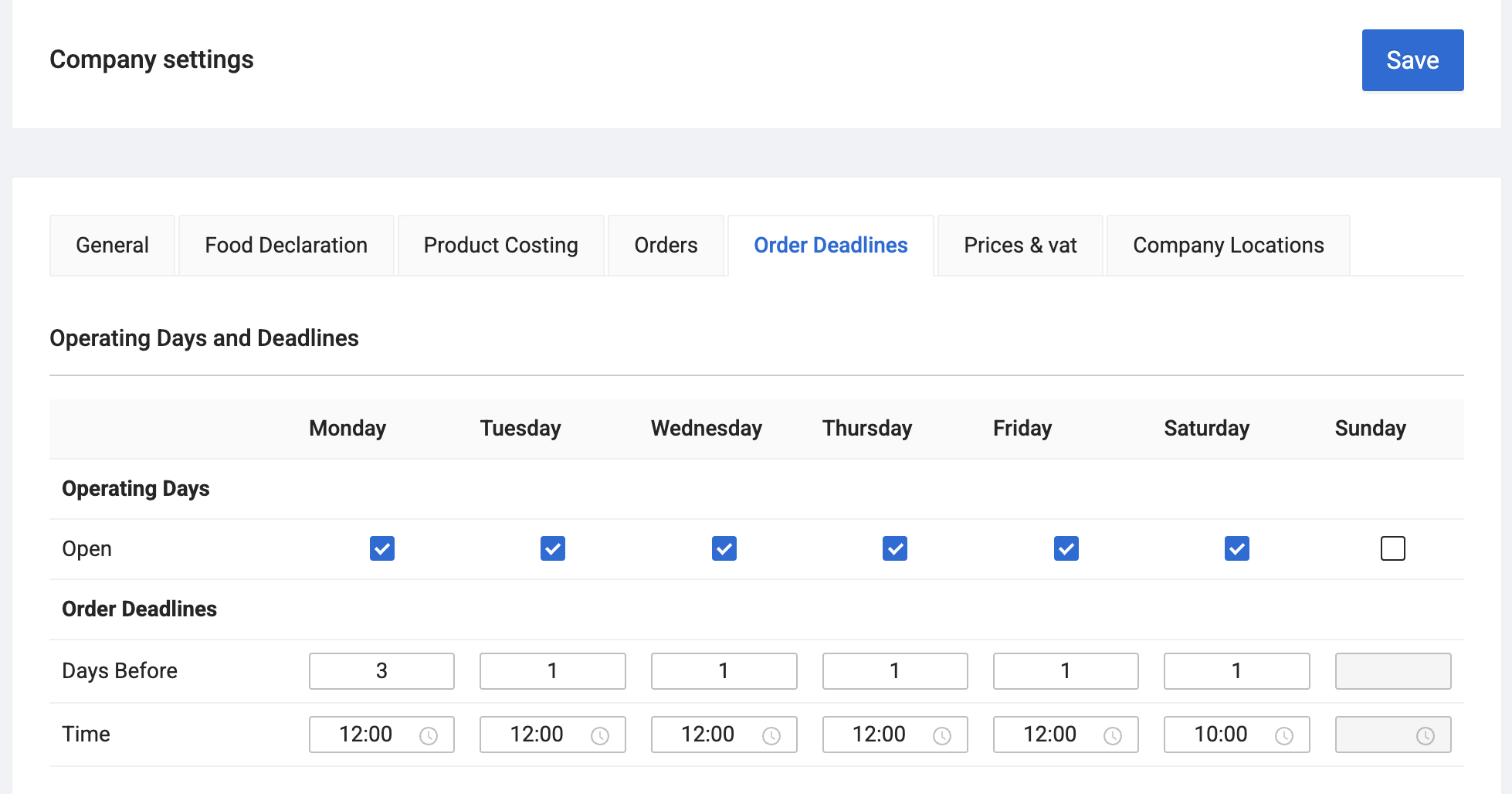
You can differentiate deadline by each weekday, in the following way;
- Enable or disable the weekdays you are open for deliveries.
- For each weekday, specify the number of days before delivery the order must be placed. E.g. for delivery on Monday, you need to place your order 3 days in advance (Friday) before 12.00.
2. Article ordering rule
You can tailor order deadlines and availability for individual articles or groups of articles. This is particularly useful when certain fresh made articles need special handling. For example:
- You may want sourdough breads to require two extra days of notice, because it takes longer time to prepare and make.
- You could restrict croissant deliveries to Fridays and Saturdays, because you only make them for the weekends.
These customizations are simple to manage, allowing for specific article based adjustments to suit your operational needs.
3. Customer ordering rule
Customer ordering rules are helpful when dealing with various types of clients who may require special arrangements. For instance:
- You want longer deadlines for some of your customers because their location means longer delivery time.
- Some customers may require Sunday deliveries, while others do not. These exceptions can be easily configured.
- One of your VIP-customers demands a short 1-day order deadline, whereas everyone else has three days deadline.
| User tip |
| You may not be able to provide the whole range of articles to customers with short order deadline. For example, some articles may require longer time to make fresh than what the pre-agreed customer deadline allows. With sales catalogues, you can restrict which articles the customer can order, to guarantee deliveries within short notice. Simply create a sales catalogue and assign it to the customer. |
The flexibility of customer ordering rules ensures that customer-specific requirements are met, while still maintaining control over article availability and deadlines.
4. Deviating deadlines for specific dates
During holiday periods or specific events, you may need to apply deviating deadlines for specific dates. For example:
- All orders might need to be submitted before December 20th for the Christmas holidays.
- Or you might need all orders to be submitted at least 4 days prior to delivery during Easter.
This feature allows for temporary adjustments without altering the overall general order deadlines settings, providing adaptability during peak periods or special circumstances. Click here to learn more about defining closed days and deviating deadlines.
5. Priority of deadlines
Given that we offer the flexibility to arrange order deadlines for both customers and articles, as well as for specific dates, the system needs to know how to prioritize between the different rules if several of them come into play at the same time.
Generally speaking, as soon as you have defined an ordering rule for a customer, the system will ignore all other rules except for the deviating deadlines defined for specific dates.
- Deviating deadlines (read more here)
- Customer order rule setting
- Article order rule setting
- General order deadline
Here are three examples to illustrate how the system prioritizes;
Scenario 1
| General order deadline | 1 day in advance |
| Special cake order rule | No order rule setting |
| VIP customer order rule | No order rule setting |
Result: All customers and all articles have a 1 day order deadline prior delivery, including the special cake and the VIP customer.
Scenario 2
| General order deadline | 1 day in advance |
| Special cake order rule | 3 days in advance |
| VIP customer order rule | 2 days in advance |
Result: The VIP customer has 2 days deadline for all articles, including the special cake. Other customers have a 3 day deadline for special cakes, and 1 day for all other articles.
Scenario 3
| General order deadline | 2 day in advance |
| Croissants order rule | 4 days in advance |
| VIP customer | No order rule setting |
Result: The specific customer has 4 days deadline for the croissants, and 2 days deadline for all other articles.
Scenario 4 Date-specific deviating deadlines
The system will first look for date specific deviating deadlines before determining the order deadline. We recommend you to read this article understand this scenario further.
6. Keeping it simple
While MyFoodOffice allows flexible settings, we advice you to keep it simple to make sure you are able to manage your own company's settings. We recommend you follow these principles
- Let the general order deadline be the shortest possible order deadline.
- Article ordering rules should reflect your own internal needs, e.g. production lead time, that could extend the order deadline if needed.
- Customer order deadlines should generally speaking always be stricter than any article ordering rule, so you know that you can deliver all articles your offering.
- If a customer require higher service level, i.e. short order deadline before delivery, make sure you define a sales catalogue that prevents that customer from ordering articles that has a lead time longer than the order deadline.